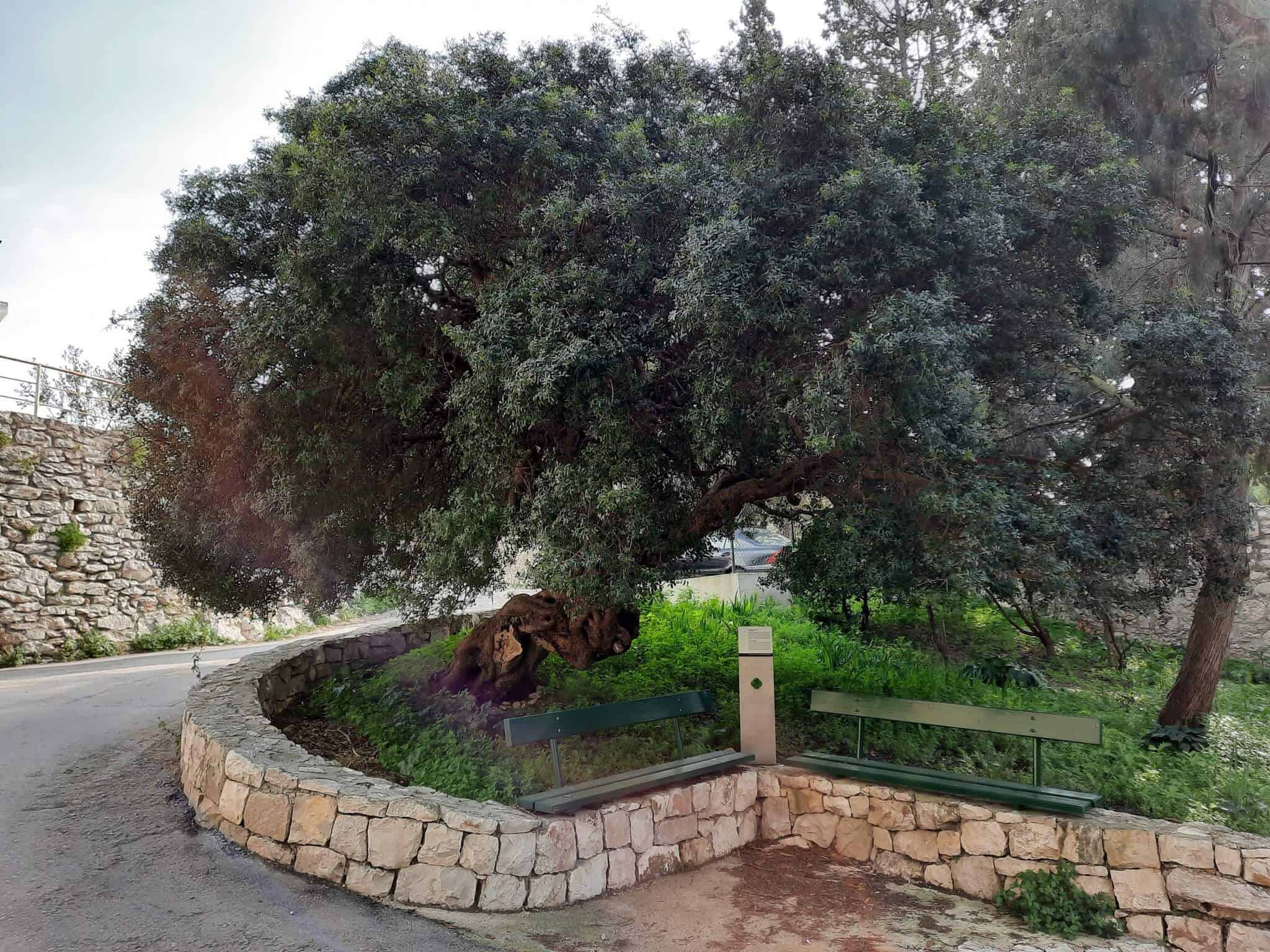
If you find yourself close to our hotel Pharia in Hvar, you can visit one rather old tree nearby hotel, only a few meters below.
It is the tree known as Pistacia lentiscus, and it is more than one hundred years old 😊
Some facts about it
The plant is evergreen, from 1 to 5 m high, with a strong smell of resin, growing in dry and rocky areas in Mediterranean Europe. It resists heavy frosts and grows on all types of soils and can grow well in limestone areas and even in salty or saline environments, making it more abundant near the sea. It is also found in woodlands and almost deforested pasture areas, Kermes oak woods, wooded areas dominated by other oaks, garrigues, maquis shrublands, hills, gorges, canyons, and rocky hillsides of the entire Mediterranean area.
It is a typical species of Mediterranean mixed communities which include myrtle, Kermes oak, Mediterranean dwarf palm, buckthorn and sarsaparilla, and serves as protection and food for birds and other fauna in this ecosystem. It is a very hardy pioneer species dispersed by birds. When older, it develops some large trunks and numerous thicker and longer branches. In appropriate areas, when allowed to grow freely and age, it often becomes a tree of up to 7 m. However, logging, grazing, and fires often prevent its development.
The leaves are alternate, leathery, and compound paripinnate (no terminal leaflet) with five or six pairs of deep-green leaflets. It presents very small flowers, the male with five stamens, the female trifid style. The fruit is a drupe, first red and then black when ripe, about 4 mm in diameter.
In tourist areas, with palmitos or Mediterranean dwarf palms, and exotic plants, it is often chosen to repopulate gardens and resorts, because of its strength and attractive appearance. Unlike other species of Pistacia, it retains its leaves throughout the year. It has been introduced as an ornamental shrub in Mexico, where it has naturalized and is often seen primarily in suburban and semiarid areas where the summer rainfall climate, contrary to the Mediterranean, does not hurt it.
Usage of Pistacia lenticus
Mastic gum is principally used either as a flavoring or for its gum properties, as in mastic chewing gum. People in the Mediterranean region have used mastic as a medicine for gastrointestinal ailments for several thousand years. Apart from its medicinal properties and cosmetic and culinary uses, mastic gum is also used in the production of high-grade varnish.
Here in Hvar, its leaves were used for dyeing fishing nets. Also, therapeutic essential oils are extracted by distillation of leaves.
Bellow in the picture you can see our Pistacia lentiscus tree more than one hundred years old 😊 so come and visit some living history 😉